Video Storytelling
How to Outline Any Video in 5 Simple Sentences Before Hitting Record
You spend hours in pre-production or editing your videos only to discover they have no clear point? The Five-Line Story Method is the layman's five-beat formula-Setup, Desire, Conflict, Change, and Result-that ensures you hit upon your core story before you even start to film.
By Ediskool
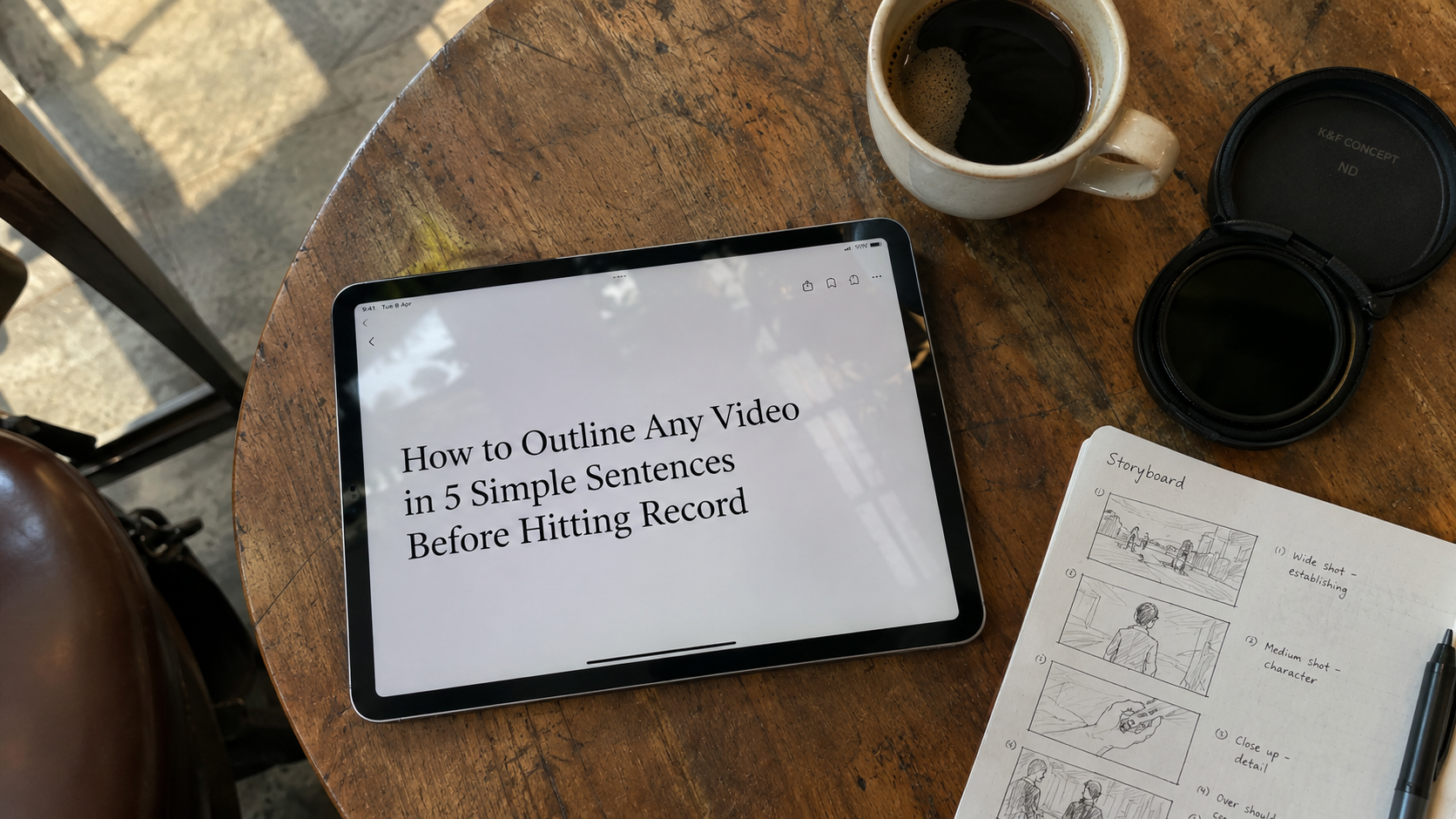
How to Outline Any Video in 5 Simple Sentences Before Hitting Record
Table of Contents
- Introduction: Find Your Video’s Core Before You Film
- A Clear Story Core Keeps Filmmaking Decisions in Check
- Too Many Creative Choices Can Hide the Story
- Strong Editing Cannot Replace a Missing Story
- The Five-Line Story Method Gives Your Video a Clear Blueprint
- Situation and Desire Give the Audience a Starting Point
- Conflict, Change, and Result Create Movement
- Each Story Beat Gives Viewers a Reason to Keep Watching
- Desire Builds Curiosity and Emotional Investment
- Conflict and Change Keep the Story Moving
- Familiar Stories Show How the Five Lines Work
- The Lion King Fits the Five-Beat Structure
- A Creator’s First YouTube Video Has a Clear Story, Too
- Use the Five-Line Story Method to Expand a Script
- Add Detail Gradually Without Losing the Core
- Return to Your Five Lines When the Project Feels Overwhelming
- Final Thoughts: Start Your Next Video with Five Lines
- Frequently Asked Questions (FAQ)
- Conclusion
- Disclaimer
You've spent hours planning a video and still don't know what to say? Or do you jump on camera hoping the story will show up in the edit? The five-line story helps you find the heart of your video before those hours go by.
A refined edit won't do a story that doesn't go anywhere. Gear, transitions, voice-overs, and color correction all take time, but nothing brings a good idea together better.
The method uses five beats: 1) the setup, 2) the motivation, 3) the struggle, 4) the journey, and 5) the resolution. It has one line for each, which makes a great starting point for a complete script.
A Clear Story Core Keeps Filmmaking Decisions in Check
Making a film is a constant process of decision-making. When you are making a particular shot, a transition between two shots, or picking out music, you realize that you have forgotten what you were shooting for. This sentence can help you recall what you intended to capture for your video. It can help you realize if a particular decision you are making contributes towards fulfilling an objective of the video.
Too Many Creative Choices Can Hide the Story
You can easily get caught up rewriting a beat sheet, throwing it away, and starting over. Maybe you skipped planning altogether and jumped into production, figuring you can sort it all out in editing. Now you have a timeline of garbage with no idea of what you wanted your audience to feel or what you intended them to take away from your production.
The more decisions you make, the more likely you are to get lost in the weeds instead of seeing the bigger picture. This can happen whether you're filming alone or with a crew. Having a strong story core will help keep your big picture front and center.
Strong Editing Cannot Replace a Missing Story.
src="https://ediskool-assets-782989862721.s3.ap-south-1.amazonaws.com/uploads/blog-content/1791540335043-737268786.png" loading="lazy" decoding="async"
Camera magic and the power of editing can't do the job of explaining why you need to care. It makes it great to look at, but if you didn't prep for it, it is worth nothing. First off, know what you are doing and, more importantly, why you are doing it. You want to ensure you have a purpose for the production.
This is how the five -line story comes into play. Having that information before you start looking at shots, recording voiceovers, or grading the footage is what gives all of those things a purpose. With a story in place, it all makes sense.
The Five-Line Story Method Gives Your Video a Clear Blueprint
src="https://ediskool-assets-782989862721.s3.ap-south-1.amazonaws.com/uploads/blog-content/1791540132662-715910111.png" loading="lazy" decoding="async"
Write one line per one of five beats. Give it some time and don't stress over every beat, everything, every detail. What we want is the whole shebang, right in front of us.
Once your five-line outline is ready, take a moment to check whether each part contributes to the overall story. Think about what the viewer needs to hear, what they should see on screen, and how one point leads into the next. If you want to explore this process further, Adobe's guide to writing effective video scripts explains how a script can guide both the message and the production process.
Situation and Desire: Give the Audience a Starting Point
Provides the viewers with the beginning of the story, the characters involved, and what is happening. Let the audience know enough of what’s going on to follow the story. For example: “A young wannabe filmmaker wants to share her stories with the YouTube community.”
The want describes what he/she wants, needs, or desires. It tells us what the story is about and what is at stake for the audience. In the clip, the filmmaker wants to shoot videos telling stories from the heart.
Conflict, Change, and Result Create Movement
The conflict is the obstacle that makes the want challenging to get to. This can be another character or an external or internal force such as fear or lack of self-confidence. If there is no fight, then there is no fight, and there is no reason to hold on.
A shift is the turning point, event, moment of realization, or new perspective that prompts a change in story. The ending is the conclusion, the answer, or what will be... The piece that has been carried through the beginning as an ending feeling.
Each Story Beat Gives Viewers a Reason to Keep Watching
The five beats are familiar to the audience. They are introduced; the viewers know what the character wants and ponder whether the character will succeed. Then they wait for a switch and a deserved ending.
Desire Builds Curiosity and Emotional Investment
A clear goal, a reason for the audience to care about what's next. They want to know if that character will survive or if they see the same yearning in their own lives. It doesn't matter which; it's personal.
Keep the goal simple. If the viewer cannot understand the main goal of the character, then they will not be able to decide who to support. Specificity will give them a goal to support.
Conflict and Change Keep the Story Moving
An obstacle is the place of tension. This is what puts the goal in danger. Obstacles can be anything from a writer who thinks they will run out of time to a person who doubts their own ability. The important thing is for the goal to be at risk.
A turning point marks a change. It may be an act of bravery, but, on the other hand, it may be an epiphany that changes the character's perception of what is important. This change leads the story to its end, which appears to be inevitable.
Familiar Stories Show How the Five Lines Work
You may be able to produce a short feature film summary, or you may be able to accurately produce a summary of a particular person's video on YouTube. It will not mention every detail that you want it to mention; it is not meant to, only the key highlights of the story in a brief summary.
The Lion King Fits the Five-Beat Structure
In The Lion King, the young cub in the movie is eager to become the future king of the Pride Lands. He trains hard to be a brave lion. When his father gets killed, he's left to deal with the harsh reality and flees away due to fear.
As he grows up, Simba is helped along by his friends and by a vision of his father as he matures. He returns to challenge Scar and to claim his throne. He then restores order to the Pride Lands. This is a very brief synopsis, but you can see the whole story arc here.
A Creator’s First YouTube Video Has a Clear Story, Too
This YouTube star is from the Netherlands. Has always dreamed of making videos on YouTube. He was interested in storytelling, so it took a few years before he actually began to make videos because he had the feeling that it was connected with the wrong goals.
It was then he realized that views, subscribers, and money were not the reasons he wanted to start making videos. What he knew for sure was that he enjoyed telling stories and sharing ideas. That knowledge got him started, and that very first video motivated him to keep at it.
Use the Five-Line Story Method to Expand a Script
They are a beginning, not a finished video. (You can build on those 5 lines with an outline, a script, and a shot list.) Keep an eye out to see if anything you add still relates to one of those 5 beats.
Once you have a clear outline, think about how the visuals will support the story you want to tell. Even a simple video can feel more polished when its colors are consistent and the footage matches the mood of the message. If you are editing on your phone, this simple mobile color grading guide can help you give your footage a more cinematic look.
Add Detail Gradually Without Losing the Core
Four more lines of the creator's first-video story might have filled out the story even more. Additional detail about what caused him to delay, such as "I was too old," "I don't have the right skills," or "I don't have the right gear," and three more lines could have described the relief when he gave up the dream, then the question that made him reconsider.
They add color, but they don't change the story. He has something he wants to tell; he's unsure of himself, but he has new confidence that will get him started. You could add detail forever as long as the story stays on track.
Return to Your Five Lines When the Project Feels Overwhelming
Save your short story summary for any stage of the project. You have to be able to read your summary while writing, filming, or editing the documentary to keep the main idea in mind. If you come across a shot, line, or edit that doesn't relate to one of the five beats, question if the video needs it.
This doesn't mean that all shots have to relate explicitly to the plot. Pauses or visual cues could be used to establish a certain mood or atmosphere that will help the viewers relate to a character later. Above all, make sure you're making intentional choices rather than defaulting to including whatever information you can.
FAQ
Q1. What is the Five-Line Story Method?
The five lines are the five basic beats of a story in a very simplified story structure. Each of the five main storylines of the video is broken into a single line: Situation (Setup), Desire (Motivation), Conflict (Struggle), Change (Journey), and Result (Resolution).
Q2: What are the five beats?
The five beats are
Synopsis: Introduces the beginning scene, the characters, their names, and other initial details.
Goals/Aspirations: Explains what this character hopes to achieve or gain from the story.
Conflict: State the obstacle or difficulty that makes the goal so hard to attain.
Step: Whether it's a crisis, a new way of viewing the problem, or a decision that is made.
Result: Shows the outcome and whether it has improved or worsened since the beginning.
Q3: Is this just for normal YouTube videos, or has it been done for feature films?
Yes. This method is equally effective for long-form stories. Whether you're summarizing a massive feature (like The Lion King, for example) or a short Creator vlog about how to create a YouTube video, the five-line structure distills the main storyline without all the specifics.
Q4: So I can't simply tell the story in editing?
Final editing, voiceovers, and camera movement can mask a story but cannot replace it. If you don't give a story to the final edit, you'll end up with a packed-filled timeline and a disconnected piece.
Q5: How do I convert my five lines into a script/shot list?
The Five Lines as your anchor blueprint. When you are writing your shot list or your detailed script or your beat sheet, constantly reference back to the five lines. If any shot, scene, or transition doesn't take you towards one of those five lines, you need to ask yourself: Is that shot really necessary?
--------------------------------------------------------------------------------------------------------------------------------------------------------------------------------
Choosing the right creative tools is just one part of making better content. Before you start editing, it also helps to plan your video idea clearly. Read our guide on how to outline any video in 5 simple sentences before hitting record to give your next project a clearer direction.
Final Thoughts: Start Your Next Video with Five Lines
Write one sentence each for the situation, desire, conflict, change, and result before you start shooting. These five lines show you the shortest route from your opening shot to the final scene. They also show you exactly when you're working against your story.
When your core is clear, build on it to add the shots and content your video will require. If you want a little help translating the five lines into a shot list and edit plan, check out the video where the creator's Story Starter Kit is one of several approaches he mentions. Otherwise, just grab a blank sheet and five lines and go to town on your next project.
Your Next Creative Skill Starts Here
One tutorial can give you an idea. Consistent learning turns that idea into a skill.
Stay connected with EDISKOOL for practical knowledge, creative resources, AI tools, editing workflows, and fresh inspiration for your next project.
Get quick tips, creative inspiration, AI discoveries, and editing ideas.
Follow practical conversations around AI, editing, content creation, and the creator economy.
Telegram
Access useful editing resources, templates, plugins, PDFs, workflow guides, and EDISKOOL updates.
EDISKOOL Courses
Go beyond tutorials with practical learning in video editing, motion graphics, AI creativity, and content creation.
Disclaimer
This article and the Five-Line Story Method are for educational purposes and general information only. Video production pipelines are different for each project, depending on the scope, team, and your creative wishes. This article contains all trademarks and media references (including The Lion King), and the rights to them are owned by those responsible for the specific media we reference and display.
Last Updated: October 9, 2026
Review and maintenance by professional filmmakers at EDISKOOL to assure a practical accuracy in a broad scope of modern video storytelling, pre-production and YouTube scripting.